
What Information Does AI Use for Sports Predictions?
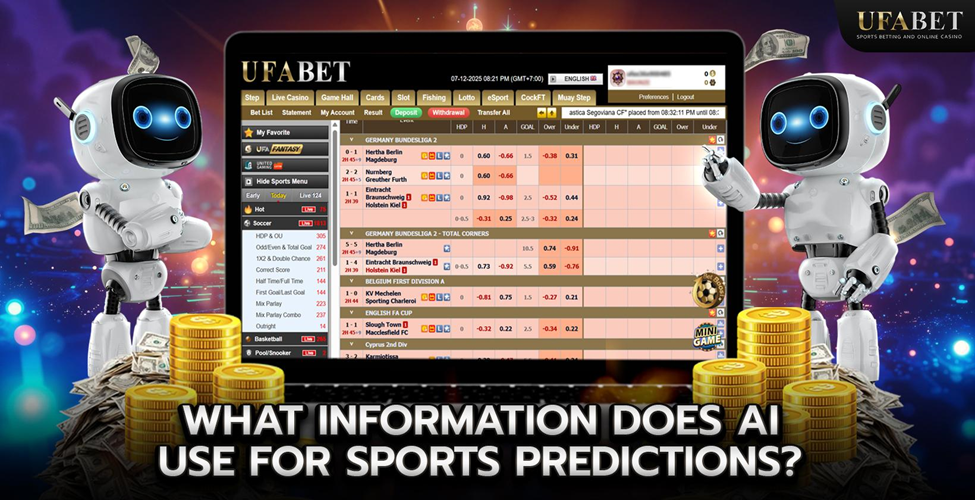
The rise of technology has transformed how sports matches, teams, and individual players are analyzed. AI systems process vast amounts of data far rapidly compared to humans, making them increasingly relevant in performance analysis, match forecasting, and sports betting research. AI helps identify patterns that are difficult to detect through traditional observation alone. AI models commonly analyze historical match data, team and player statistics, recent form, injury reports, tactical setups, head-to-head records, and in-game metrics such as possession, shots, and pressing intensity. Some systems also factor in contextual data like fixture congestion, travel distance, and weather conditions. AI assists bettors in pattern recognition, probability modeling, and real-time processing, allowing it to adapt quickly and churn information. Insights generated by AI provide odds analysis and match evaluation on football betting platforms, but the technology does not guarantee outcomes. Bettors structure decisions logically, reduce emotional bias, and understand risk when placing football bets with the help of AI.
1. Historical Match Data
Historical match data refers to records of past games that AI systems use to identify long-term patterns and tendencies in football. The information is essential for predicting match outcomes because it provides context beyond short-term form, helping models understand how teams typically perform in different situations. AI estimates probabilities such as win rates, goal frequency, clean sheets, and comeback likelihood by analyzing historical data. The technology reduces randomness and improves forecast accuracy, especially when combined with recent performance indicators. AI systems commonly examine final scores, goal timing, home vs away performance, head-to-head history, league position trends, tactical formations used, and performance against similar opponents. Advanced models also track how teams react after conceding, their consistency under pressure, or performance in congested fixture periods. Historical match data provides the fundamental layer for AI predictions, allowing systems to compare current matchups against thousands of similar past scenarios to generate informed outcome probabilities.
2. Player Performance Statistics
Player performance statistics are a critical data source for AI when predicting football match outcomes, as individual players often influence results more directly than team-level trends. By analyzing metrics like expected goals (xG), key passes, and defensive actions, AI models can evaluate current squad strength and the potential impact of key players during a match. These individual insights are most effective when integrated with broader team statistics, such as the tactical pressing intensity and ball recovery rates showcased by elite squads like Leverkusen, which provide the necessary context for individual brilliance. This comprehensive approach is especially vital when predicting outcomes affected by injuries, suspensions, or squad rotations, as changes in the lineup significantly shift match probabilities. Ultimately, by combining fitness levels, disciplinary records, and performance against specific tactical systems, AI creates precise predictions that reflect real-time on-field influence rather than relying solely on historical team results.
3. Team Tactics & Play Style Metrics
Team tactics and play style metrics are essential for AI when predicting match outcomes because they explain how a team plays, not just what results it produces. The metrics help AI understand tactical compatibility and mismatches between opponents. AI uses tactical data to evaluate whether one team’s style is likely to dominate the other’s. For example, an intensely pressing team overwhelms opponents that struggle with buildup, while a deep defensive block decreases the chances of winning for others. Tactical fit often determines match flow and scoring opportunities. AI systems analyze formations, pressing intensity, possession structure, build-up speed, defensive line height, width usage, and transition frequency. Advanced models also track entries into dangerous areas, areas creating scoring opportunities, and reliance on set pieces. AI predictions become contextual and realistic by combining tactical metrics, allowing models to anticipate how matches progress rather than relying only on past results or raw statistics.
4. Real-Time Injury, Suspension & Lineup Updates
Real-time injury, suspension, and lineup updates are critical inputs for football predictions generated by AI because they directly affect team strength and tactical execution. A single missing key player significantly affects match dynamics and expected outcomes. AI models rely on up-to-date availability information to adjust probability estimates before kickoff and during live matches. Late injuries or suspensions weaken defensive structure, reduce attacking efficiency, or force tactical changes. Accurate lineup data helps AI avoid outdated assumptions based on full-strength squads. AI systems track confirmed starting lineups, last-minute injuries, suspensions due to cards, rotation decisions, player physical health, and positional replacements. Advanced models also evaluate impact scores that measure how much a team’s performance drops when key players are absent. AI predictions remain responsive and realistic, allowing bettors and analysts to reassess value when unexpected changes occur close to kickoff by integrating match updates in real life.
5. Weather & Environmental Conditions
Weather and environmental conditions play a meaningful role in football outcomes, making them an important data input for AI prediction models. The factors influence match tempo, player performance, and tactical effectiveness. AI uses environmental data to adjust expectations around scoring, pressing intensity, and ball movement. For example, heavy rain slows play and reduces shot accuracy, while extreme heat causes fatigue, lowering second-half intensity. Ignoring these conditions leads to overestimating attacking output or underestimating defensive stability. AI systems typically analyze temperature, rainfall, wind speed, humidity, pitch condition, and altitude. Some models also factor in stadium orientation, travel distance, and local climate adaptation, such as how well a team performs in hot or wet conditions. AI speculations improve accuracy for goal markets, bets on match dynamics, and live betting decisions by combining weather and environmental metrics.
6. Betting Market Movements
Betting market movements are a key signal that AI systems use to predict football match outcomes because they reflect how information and money flow across the betting ecosystem. Odds changes often occur in response to new data, sharp betting activity, or shifting public reaction. AI monitors market movements to detect where informed bettors are placing money and how bookmakers adjust risk. Sudden or consistent odds shifts indicate insider knowledge, lineup news, or mispriced markets. Combining this data helps AI align predictions with expectations from fans and bettors rather than static models. AI systems analyze opening vs current odds, odds adjustment, betting volume changes, live movement direction, and differences across bookmakers. Advanced models also track sharp vs public money patterns and how markets respond to recent news. AI suggestions become adaptive and responsive by integrating betting market data to improve timing and value detection, especially in live betting and short-term markets.
How AI Systems Analyze Data to Predict Match Results
AI systems predict match results by integrating large, diverse datasets and processing them through statistical models and machine-learning algorithms to estimate outcome probabilities. AI begins by collecting data from multiple sources, including historical match results, player performance metrics, team tactics, injuries, weather, and betting market movements. The input data are then churned and standardized to ensure consistency. Next, AI extracts features that are most predictive of outcomes, including expected goals trends, pressing intensity, and lineup impact sources. AI applies models such as regression, gradient boosting, or Bayesian frameworks to learn the relationship between inputs and results. The models are trained and validated on past matches, then updated in real time as new information arrives (e.g., confirmed lineups and odd shifts). Finally, AI outputs probability distributions (win/draw/loss, totals, handicaps), not certainties. The end-to-end process allows AI to deliver timely, context predictions while managing uncertainty inherent in sports, including data ingestion, feature engineering, model inference, and continuous updating.
How Effective Are AI Tools for Sports Betting
AI tools are effective for sports betting when used as analytical support, not as guarantees. They provide bettors with a structured advantage by improving decision quality and reducing bias. AI processes vast datasets at a scale and speed that humans fail to match, including historical results, player metrics, tactical patterns, injuries, weather, and betting market movements. The technological advancement allows AI to identify subtle patterns, correlations, and mispriced odds that are often overlooked in manual analysis. AI predictions give bettors an advantage by quantifying probabilities, highlighting value opportunities, and updating assessments in real time as new information emerges. Bettors have consistent, data-driven decisions rather than choices made by intuition. AI also helps mitigate emotional bias, recency bias, and reputation bias that commonly affect human judgment. AI does not eliminate uncertainty as its effectiveness depends on data quality, model design, and how bettors apply insights. The strong results come when AI predictions are combined with human context, such as match importance or psychological factors, creating a balanced, disciplined betting approach.
Does UFABET provide sports predictions?
Yes, UFABET provides sports prediction insights that help bettors analyze matches effectively. UFABET supports bettors in making decisions based on predictions about pre-match data, live odds movement, and statistical match information presented across its sports betting interface. For example, a user reviews team form, head-to-head records, league standings, and live odds adjustments before placing a bet in football betting. UFABET updates odds dynamically to reflect momentum shifts, goals, cards, or tactical changes, which indirectly guide predictive judgment. Some sections highlight the market trends, such as favored sides or total goals expectations, allowing bettors to analyze probability based on public market tendencies. The tools function as practical prediction aids, while UFABET does not claim to guarantee outcomes. UFABET helps bettors form structured predictions, compare scenarios, and manage risk if used correctly, especially when combined with external analysis or AI forecasting tools.